RESPs: How Government Grants Can Grow Your Child's Education Savings
The Canada Education Savings Grant adds 20% to your contributions, up to $7,200 per child. Here's how the grant, the Canada Learning Bond and the key deadlines work.
A Registered Education Savings Plan (RESP) is one of the few places where the Government of Canada adds money to your savings. If you have children, or grandchildren, understanding how the grants work can make a real difference to what's there when they start college, university or a trade program.
How an RESP works
- You (the subscriber) open the plan for a child (the beneficiary).
- Contributions are not tax-deductible, but investment growth inside the plan is sheltered from tax while it stays there.
- The lifetime contribution limit is $50,000 per child, across all RESPs.
- When the student withdraws the growth and grants as Educational Assistance Payments, that money is taxed in the student's hands. Students often have little other income, so this frequently results in little or no tax.
The Canada Education Savings Grant (CESG)
This is the headline benefit.
- The government adds 20% on the first $2,500 you contribute each year: up to $500 per child, per year.
- Unused grant room carries forward. If you're catching up, the grant is capped at $1,000 per child per year, which takes a $5,000 contribution to reach.
- The lifetime maximum is $7,200 per child (basic and additional grants combined).
- Families with low or middle incomes may qualify for an additional 10% or 20% on the first $500 contributed each year. The income thresholds are adjusted every year.
A simple example
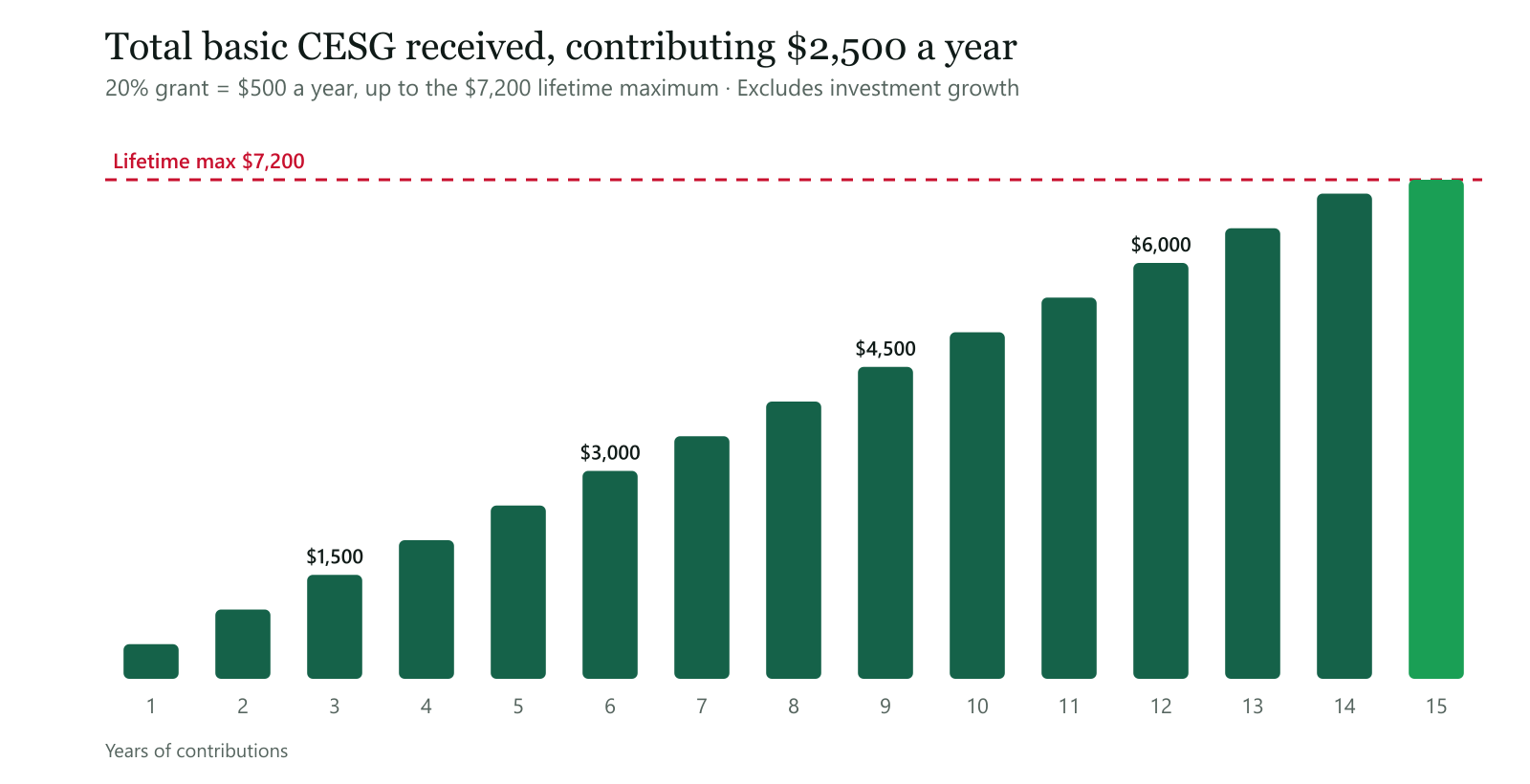
Contributing $2,500 a year earns the full $500 basic grant each year. Keep that up for about 14½ years (roughly $36,000 in contributions) and you would reach the $7,200 lifetime grant maximum, before any investment growth.
Try it with your own monthly amount and your child's age:
Interactive projection
What could an RESP grow to by age 18?
At about $209 a month or more, you're collecting the full $500 yearly grant.
- Your contributions: $45,360
- Government grants: $7,200
- Estimated growth: $24,929
Illustration only, for general education. It assumes no earlier RESP for this child, steady monthly contributions through the year the child turns 17, and a steady return. Real returns vary and are not guaranteed. It includes the basic Canada Education Savings Grant only, not the additional CESG, the Canada Learning Bond or provincial grants, which could add more for eligible families.
Watch the age deadlines
- The CESG is paid on contributions made up to the end of the calendar year the child turns 17.
- For children aged 16 and 17, the grant is only available if the RESP already had meaningful savings earlier. That means either at least $2,000 contributed (and not withdrawn) before the end of the year they turned 15, or at least $100 a year in any four years before the end of that year.
In other words, starting before age 15 keeps the most options open.
The Canada Learning Bond (CLB)
For eligible lower-income families, the Canada Learning Bond can add up to $2,000 to a child's RESP, with no contribution required:
- $500 for the first year of eligibility
- $100 for each additional year of eligibility, up to and including age 15
- Available to children born on or after January 1, 2004
- It can be requested up until the day before the child turns 21
If your family may qualify, it's worth checking. Many eligible children never receive it simply because no RESP was opened.
Provincial programs
Some provinces offer their own incentives. For example, British Columbia has a one-time grant of $1,200, and Québec offers a refundable tax credit worth up to $3,600 over the child's lifetime. Check what's available where you live.
Questions worth asking yourself
There is no one-size-fits-all answer. Tick each one off as you think it through:
Self-check
0 of 5 considered
Is an RESP set up for each child?
Grants are only paid into an RESP, so the plan (and the child's Social Insurance Number) needs to be in place before contributions can earn them.
Am I contributing enough for the full grant?
Contributing $2,500 a year, about $209 a month, collects the full $500 basic grant for that year.
Is there unused grant room I could catch up on?
If you started late or missed years, unused grant room carries forward. You can collect up to $1,000 of grant a year while catching up.
Could my family qualify for extra help?
Eligible families may receive the additional CESG or the Canada Learning Bond, which needs no contributions at all. Some provinces add their own programs.
Am I starting before the child turns 15?
Grants at ages 16 and 17 depend on savings built up before the end of the year the child turned 15.
The bottom line
The RESP grant is essentially a 20% boost on your contributions, up to set limits, and starting early makes it easier to collect the full amount. How much to contribute, and how to invest inside the plan, depends on your family's budget and goals.
Sources (Government of Canada):
Keep reading
Related articles
TFSA vs RRSP: How to Think About Which One Comes First
Both accounts help your savings grow with less tax, but they work in opposite ways. Here's a plain-language comparison using the 2026 limits.
Term vs Permanent Life Insurance: A Plain-Language Guide
Term insurance covers a set period; permanent insurance lasts a lifetime and can build cash value. Here's how they differ and the questions to ask before choosing.
Segregated Funds Explained: Investing With an Insurance Guarantee
Segregated funds look like mutual funds but are insurance contracts, with guarantees at maturity and death. Here's how they work, what they cost and what to check before you invest.