
TFSA vs RRSP: How to Think About Which One Comes First
Both accounts help your savings grow with less tax, but they work in opposite ways. Here's a plain-language comparison using the 2026 limits.
If you've ever stood at your bank's website wondering whether your next deposit should go into a TFSA or an RRSP, you're not alone. It's one of the most common questions we hear at our seminars.
The short version: both accounts shelter your investments from tax while they grow. The difference is when the tax break happens. An RRSP gives you a break today; a TFSA gives you a break later.
The Tax-Free Savings Account (TFSA)
- Contributions are not tax-deductible. You put in money you've already paid tax on.
- Growth and withdrawals are tax-free. Interest, dividends and capital gains earned inside the account are not taxed, and neither is taking the money out.
- Withdrawals come back as room. Whatever you withdraw is added back to your contribution room on January 1 of the following year.
- Eligibility: room starts building from the year you turn 18, as long as you're a resident of Canada.
How much room do you have?
The annual TFSA dollar limit for 2026 is $7,000. Unused room carries forward indefinitely, so if you've been 18 or older and a resident of Canada since the TFSA began in 2009 and have never contributed, your total room in 2026 is $109,000.
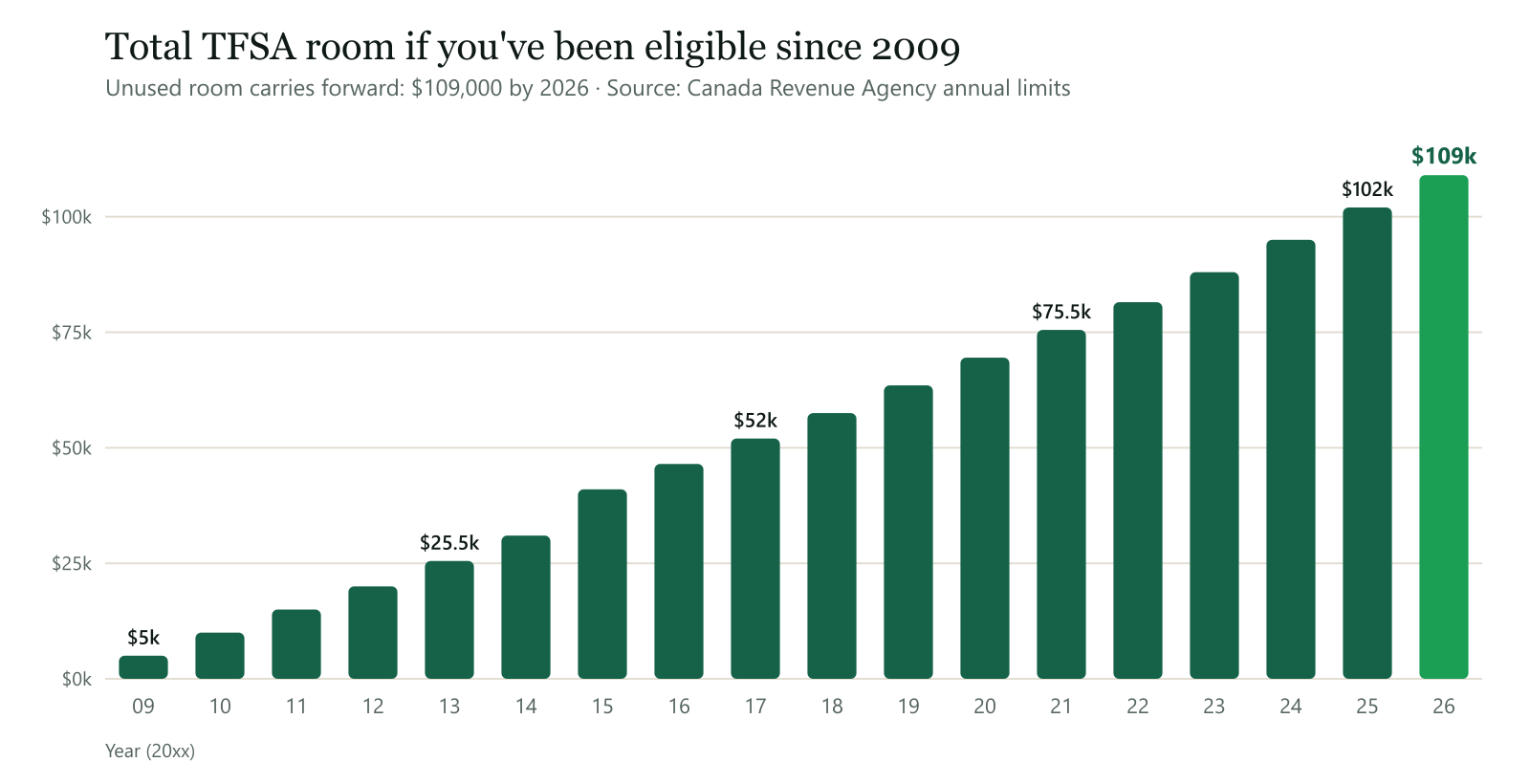
Want to see your own number? Slide to the year you turned 18 (or became a resident of Canada). Room builds from then, whether or not you ever opened an account.
Interactive calculator
How much TFSA room have you built up?
Estimate only, for general education. Your actual room depends on your full contribution and withdrawal history. Withdrawals are added back on January 1 of the following year. Confirm your room in your CRA My Account before contributing. Over-contributions are taxed at 1% per month.
Be careful not to over-contribute: excess amounts are taxed at 1% per month for as long as they stay in the account. Your personal room is shown in your CRA My Account. Just keep in mind that it may not yet include this year's transactions.
The Registered Retirement Savings Plan (RRSP)
- Contributions are tax-deductible. Every dollar you contribute can reduce your taxable income for the year.
- Growth is tax-deferred. You don't pay tax while the money stays invested.
- Withdrawals are taxable. Money you take out is added to your income in the year you withdraw it.
- It has an end date. An RRSP must be converted (for example, into a RRIF or an annuity) or withdrawn by the end of the year you turn 71.
Your RRSP room is generally 18% of your previous year's earned income, up to a yearly maximum. That maximum is $33,810 for 2026 (and $35,390 for 2027). Pension adjustments from a workplace plan reduce it, and unused room carries forward. Your exact limit appears on your latest Notice of Assessment.
Enter last year's earned income to estimate the new room it creates:
Interactive calculator
Estimate your new RRSP room
18% × $0 = $0
At $187,834 of earned income or more, you reach the 2026 maximum of $33,810. Estimate only, for general education. Your actual deduction limit is reduced by any pension adjustment from a workplace pension, increases with unused room carried forward from earlier years, and is shown on your latest Notice of Assessment. “Earned income” for RRSP purposes can include more than salary.
Side by side
Both accounts let your investments grow without yearly tax. Here's where they differ:
Summary only, for general education. Rules and limits change, so check the CRA for current details.
Questions worth asking yourself
There's no one-size-fits-all answer, but these are the factors people commonly weigh. Tick each one off as you think it through:
Self-check
0 of 5 considered
What's my tax rate now vs. later?
The RRSP deduction tends to be most valuable when your income today is higher than you expect it to be when you withdraw. If your income is modest now and likely to rise, the TFSA's tax-free withdrawals may matter more.
Do I need flexibility?
TFSA money can be withdrawn at any time without tax, and the room comes back the next year. RRSP withdrawals are taxed, and in most cases that room is gone for good.
Does my employer match?
Many group RRSPs match part of what you contribute. That's a benefit many people don't want to leave on the table.
Am I buying a first home?
The RRSP Home Buyers' Plan lets eligible first-time buyers withdraw up to $60,000 for a qualifying home. The FHSA is another option, and the two can be used together.
How will withdrawals affect benefits in retirement?
RRSP and RRIF withdrawals count as income. TFSA withdrawals do not, which can matter for income-tested government benefits.
The bottom line
A TFSA and an RRSP aren't competitors. Many Canadians use both, for different goals. The right mix depends on your income, your timeline, your goals and your other benefits. That's exactly the kind of thing a no-obligation conversation can help clarify.
Sources (Government of Canada):
Keep reading
Related articles

The FHSA Explained: Saving for Your First Home, Tax-Free
The First Home Savings Account combines an RRSP-style tax deduction with TFSA-style tax-free withdrawals. Here's how it works, who qualifies and what to watch for.

Term vs Permanent Life Insurance: A Plain-Language Guide
Term insurance covers a set period; permanent insurance lasts a lifetime and can build cash value. Here's how they differ and the questions to ask before choosing.

Segregated Funds Explained: Investing With an Insurance Guarantee
Segregated funds look like mutual funds but are insurance contracts, with guarantees at maturity and death. Here's how they work, what they cost and what to check before you invest.